As many of you know, the weather here can be devastating and, sadly, deadly. It is no different in Texas.
A lot of you have asked how all of this happened. I suspect much of that curiosity comes from national media coverage and comments from Texas officials and even the White House.
While I don’t work for the National Weather Service (NWS), I want to help clarify some of the “stuff” that’s been circulating:
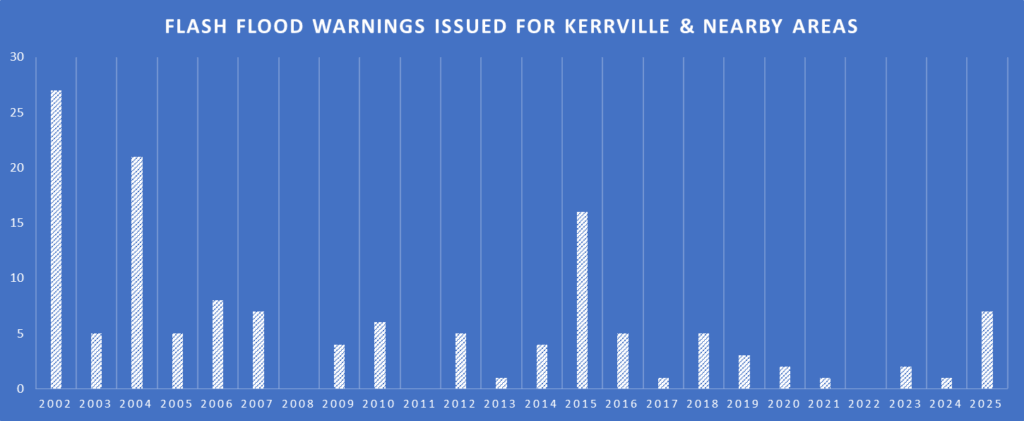
1. This area floods – a lot
I hadn’t heard the term “flood alley” before this event, but the region is well known for frequent, significant flooding. Calling it “flood alley” would be an appropriate term. The topography and tendency for storms that produce heavy rainfall make this a constant threat. Local governments in the area are typically well aware and take extra steps to prep folks about flooding potentials.
2. The NWS provided an excellent, timely forecast
Some have tried to suggest otherwise, but the NWS did an outstanding job issuing watches and warnings with ample lead time. Despite staffing challenges, they pulled in extra personnel ahead of the event to make sure they could effectively alert the public. And, frankly, even with the “extra” people on hand, one could probably argue that they were still under-staffed for this kind of event.
3. River flooding, like all weather, is not perfectly predictable
The NWS can estimate how rainfall might impact river levels, but it’s not a simple or straight-forward formula. Rainfall and river response depend on a lot. Things like specific local topography and soil type to current soil saturation, rainfall intensity, and the physical shape of the river channel itself. What makes it even more difficult is that every point along a river behaves differently. A section upstream may see a quick rise from fast runoff on steep terrain, while a downstream section might lag in response, swell more gradually, or even rise again later due to backwater effects.
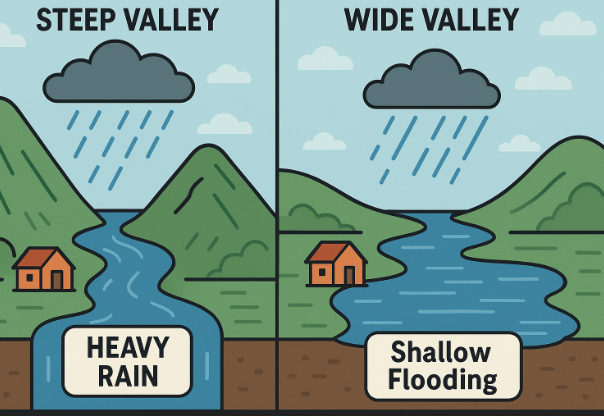
Rainfall that falls in one part of a basin might funnel rapidly into tributaries, while rain falling just a few miles away may soak into dry ground or move slowly depending on terrain and land use. Add in urban surfaces, dams, levees, or natural obstructions, and the picture becomes even more complicated. Forecasting river levels means accounting for all of this in real time, often with limited observations and uncertain rainfall forecasts. It’s less like plugging numbers into a formula and more like solving a dynamic puzzle—one where every new piece of rain can shift the outcome downstream.
4. Staffing cuts didn’t cause the event, but it made the impacts worse
While reduced staffing didn’t create the flooding, it can make these events harder to manage. When offices are short-staffed, non-emergency public outreach is often the first thing to get cut. Those outreach efforts are essential for working with vulnerable places like these summer camps and RV parks, that ended up inundated, to help them understand their flood risk and how to receive the proper warnings.
5. Funding matters
No forecast or messaging will ever be flawless. Sadly, that’s just reality. The goal is to minimize as many failure points as possible. When we cut resources for forecasting and communication, we create more opportunities for disaster to escalate and become more impactful to human life.
As an aside, just to broach a few of the other topics….
— The government isn’t creating this weather and inflicting suffering on the American people purposefully. Save it. Aside from what I’ve discussed previously about the impossibility of changing the weather with a known, desired outcome…. The people in our government can barely agree on a budget so I doubt they would all agree on a plot to specifically harm a group of children and their families in a small town of rural Texas. Anyone suggesting such nonsense anywhere on this page will get immediately banned. I have no time for it.
— The global climate is changing and the consequences are real. Low-probability extreme weather events are becoming more likely. A 1-in-1,000 event is quickly turning into a 1-in-500 event. A 1-in-100 event is quickly turning into a 1-in-50 event. Because of that, an investment in better weather forecasts and communication has a direct impact on our ability, as humans, to survive these increasingly likely low-probability events. Honestly, I could write an entire piece on how low-probability events are increasing in likelihood, but suffice to say, we are watching this change nearly every day and it is becoming so frequent that a lot of weather forecasters (like me) are having difficulty defining the “edge” of possible outcomes.
— Could this happen here? It did. Back in 2016. We ended up in a situation where parts of the area picked up between 8” and 15” of rain overnight when we expected 2” to 4” because a stalled “cold pool” created a situation where a strong surge of Gulf moisture over-ran it and dumped a ton of rain across Marion, Lamar, Forrest and Perry counties very quickly. Then, it happened again, when a storm “train” developed in 2019 and flooded out parts of Petal. Flooding is common and flash flooding from low-probability outcomes is increasing in likelihood.
— Weather wasn’t political until politicians made it so. I think we can all agree that we want to be warned about bad weather and we want those warnings as soon as we can get them. I think we can all agree that investing in preparedness and resiliency to weather events is well worth it. The degree to which we invest is where, understandably, things get tricky. A few extra bucks per year from each of us, though, is better than burying children. I think we all have a penny per day to help make sure that people don’t die because they didn’t know a storm was coming. Politicians can turn this into theatre all they want, but I think almost everyone would agree with everything I wrote in the previous few sentences.
I know this was a rather long post, but staying properly informed takes time. Sometimes things can’t be summed up in a 90-second news clip or a 30-second voiceover video on your favorite social media outlet.
In an age where and media (audio and video) can we created so quickly with scenes and narration designed to manipulate your brain… it is really, really, really, REALLY, important to make certain the things your consume are rooted in reality and actuality and not just something that ‘feels’ right or ‘sounds reasonable’ at first glance.


