This site and its app are devoted to Science topics. Usually Meteorology. Sometimes Astronomy and Geology. Other times, though, I talk about Social Science and Psychology.
Today is a blend of a few of them.
I saw this post today:
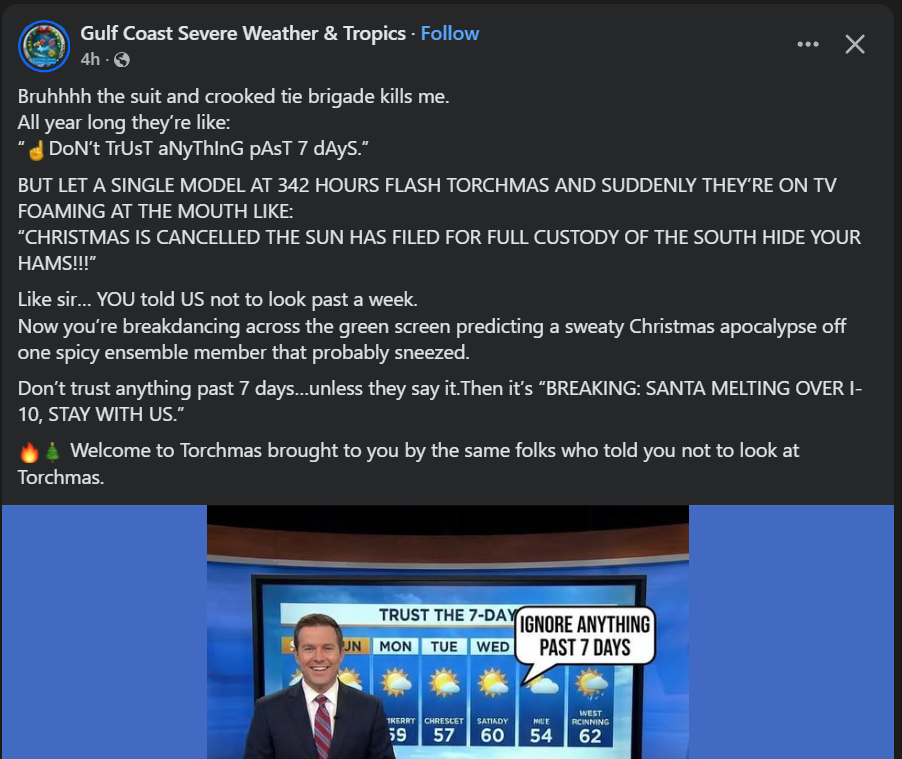
And I’m not picking on this page specifically. I left the name up there -on purpose- so folks don’t think I’m hiding something or “gunning for someone” because I am not. Heaven help me if the fans are as rabbid and unique as “Mike’s” fans.
But this single post really, really….. really highlights the largest problem with the general discourse of weather online, “The Internet” as a whole and Social Media in particular. It isn’t the fault of the author. It is, sadly, just the way things are now.
Nuance can’t survive
Online posts are usually 100% vs. 0%, all-in or all-out, ‘with us’ or ‘against us’. And any argument is often made with an incomplete dataset. The emojis and font are aimed to grab your attention, the words and tone are aimed to illicit a response,
The post mentioned above included.
That is fine for your favorite college football team. I love Oregon State and loathe University of Oregon. They stink, we rock. Win-loss records don’t matter. I’ll always feel like that. You’re wrong if you disagree.
In the right atmosphere, with folks who enjoy good-natured joking around, it can be great.
But for weather forecasts, it isn’t the same. Even when it might, kind of, feel similar.
Because, as the post mentions, most television meteorologists say, “Don’t look more than 7 days out” because most of the things that people would see are deterministic weather models (like the one shown below). Those models render a single outcome each time. And a new outcome is rendered every 6 hours. And those outcomes tend to change with each next render. Sometimes a lot, other times a little.
And people who see those models posted by others and message their trusted source of weather info for clarity.
That stance by TV mets is less about “your team stinks, my tema rules” and more about, “I care about your sanity. I know you are less familiar with these things, so let me try to help out where I can: these things are not great. You can ignore them.”
Like this post from the same page about Christmas Eve just two days ago. The post shows a single model (there are more than 10 now, I’m pretty sure, that can see that far into the future) showing sleet and freezing rain across a large area of the eastern US.
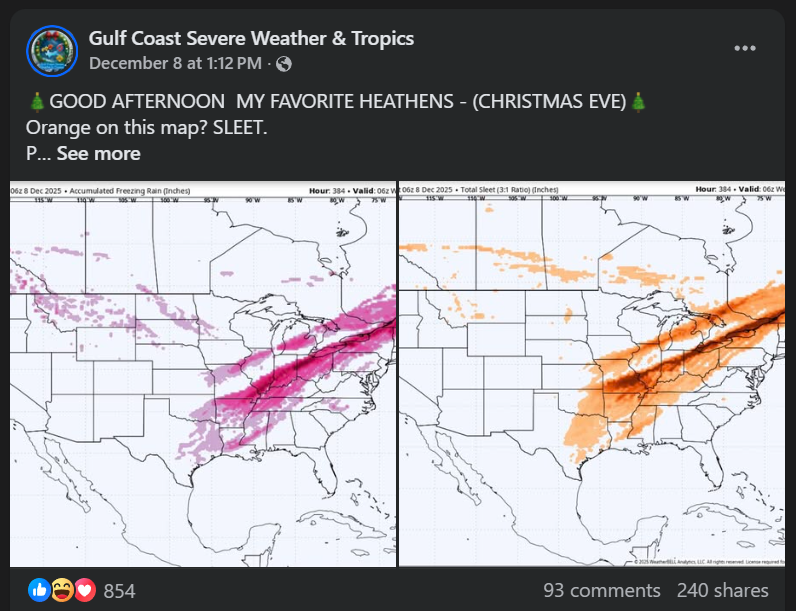
No other model showed this. But the maps caught a lot of attention from a lot non-meteorologists. Understandably. If you have to travel, that would be rough! And, for these pages, it is a great way to get engagement.
But a lot of meteorologists said, “yeah, don’t worry about that. Don’t look more than 7 days out at a single weather model.”
Understandably. And that signal disappeared with the very next rendering of that model, six hours later, and hasn’t come back since.
And I want to make sure I’m clear about this: Anyone is free to post single model outcome maps like this online. I’m not telling anyone what they can or cannot post. If you want to dedicate a page to this stuff, go for it. I disagree with the idea, sure. But that’s for me. Not for others.
So, yeah, “don’t look beyond 7 days at a single weather model” for an accurate forecast. That is good advice. Advice rooted in experience, not is disrespect.
Holiday time is a different time
The difference right now is that it is Christmas time. Things get multi-layered.
Firstly, it is a very important day to a lot of people. So there is a very high demand (much more than normal) for a view — even a general idea — on how the weather may look. So many meteorologists feel the pressure to offer a forecast when they normally would not. Most times it is a general idea. Warmer. Cooler. Wetter. Drier. Nothing fancy.
That isn’t great, but it is also understandable. People want to get a better idea about what to expect.
And secondly, this isn’t a single deterministic model showing warmth. Nor just “a single ensemble member that probably sneezed” as was cited in the original post. There is a lot of ensemble model support for warmth for many places. Including our area.
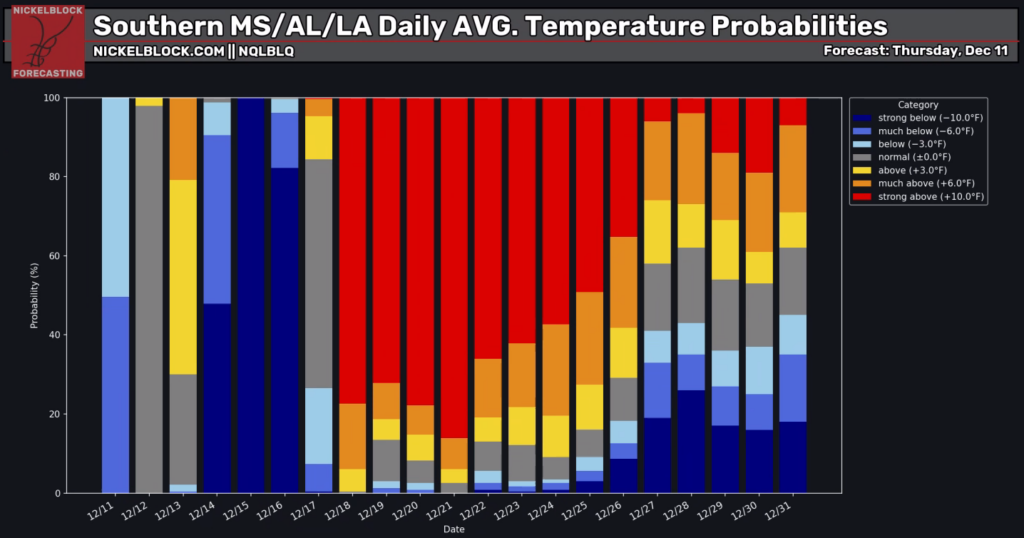
The warmth for our area is shown above using ensemble models.
Recall that an ensemble model takes one of those 10+ weather models I mentioned and runs it 30 to 50 different times, each with slightly adjusted initial conditions. By making these small tweaks, and letting the model run for each one, we get a spread of potential outcomes. This helps account for the simple fact that we never know the exact state of the entire atmosphere at any given moment.
When we run these models like this, we assume, “we can’t know exactly what the entire atmosphere of the earth looks like at a given set time… so what if we run this model and assume we are slightly wrong about a few different things.”
For example, the chart above looks at 230+ different ensemble model tweaks! In essence, it isn’t one model showing warmth, it is more than 200.
When meteorologists see this, they have more confidence in a given outcome. You would too!
If I said, of the 230 baskets Michael Jordan makes, 200 are dunks, and asked, “What kind of basket will he make next?” you’d probably say, even if you don’t know anything about basketball, “A dunk.”
Nuance, in this situation, is taking the time to expose the data that supports a given stance.
Weather is complicated, communicating it is, too
Normally, meteorologists may say, “don’t look out further than 7 days” when trying to get an accurate forecast but this time of year things are different. And that changes the “rules” a bit. For better or worse.
There is a big demand for a forecast as people make travel plans, staying-at-home plans, or are waiting on family and friends to arrive. Plus, in this particular situation, and looking at the available data for the date range in question, there is a reasonable amount of evidence to support giving a “warmer than normal” forecast to many folks.
That warmer-than-normal forecast isn’t a stretch. And it is a reasonable forecast to make.
Have some TV folks went overboard? I’m certain. You guys remember why I left TV, afterall.
But I hope the person who made this original post was going for some tongue-in-cheek and got a bit carried away. I hope they don’t actually hold the level of contempt conveyed in the tone of the writing. I also hope the folks who enjoy that page recognize that, while joking around can be fun. weather doesn’t have to be as much “them vs. us” as the post seemed to aim things.
There is a reason I tell folks to check out others (like Spinks Megginson over in Alabama), have multiple weather apps (not just mine), and watch your local TV meteorologist (even when I disagree with what they may be saying or doing).
Because we are all in this together and the weather impacts everyone. Together.
Is that stance bad for the “bottom line” on my balance sheet? I’m sure it is.
But is encouraging source diversification and trying to explain nuance (like this) important for saving lives and property while keeping everyone a bit more grounded? Absolutely.
And I’d rather have everyone properly informed, very alive and as sane as possible… than have an extra five bucks in my pocket.
Don’t stress it
Some of you guys may be thinking, “Ah, Nick, don’t worry about what others do”
I don’t. Like I said up top, people are free to live life as they see fit. I’m not here to say what people are doing is allowed or not allowed.
But I think the rest of you guys deserve to have someone hold up a lens to add focus to what you are seeing day-to-day. And add some context to the situation.
Because I’m certain some folks are reading that post and thinking, “that’s a good point, how come they can suddenly predict the weather 14 days out?!” So I wanted to offer a reason. And an explanation. And frame it across the broader scope of what is happening online everywhere.
Nothing fancy. Nothing big.