The Weather is changing.
To be more specific, the Weather Enterprise is changing. And the economy of the Weather Enterprise is changing with it.
As Television News collapses and the National Weather Service moves toward “Decision Support” we are at a very weird place in the World of Weather. Producing a forecast is getting less important. And delivering a forecast – and what it means – have taken the driver’s seat.
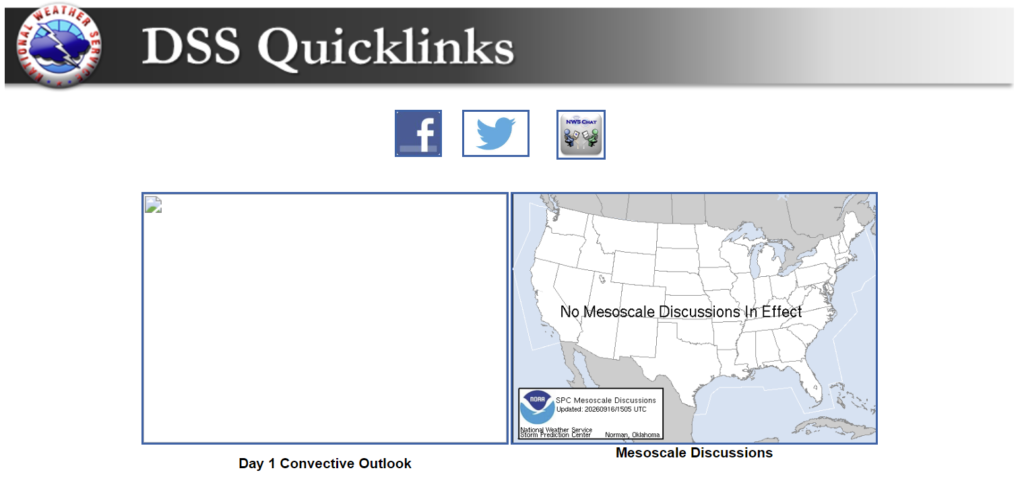
This isn’t terribly new. The real push started back in the early 2010s. But as technology improves, the cost of entry continues to come down for offering weather consulting, or running a localized or regional weather outlet, or any non-TV and non-NWS weather provider. That has been further accelerated with AI and Machine Learning.
Regionally, we have things like RedZone Weather, the Alabama Weather Network, the CenLa Weather app… and even my website and app!
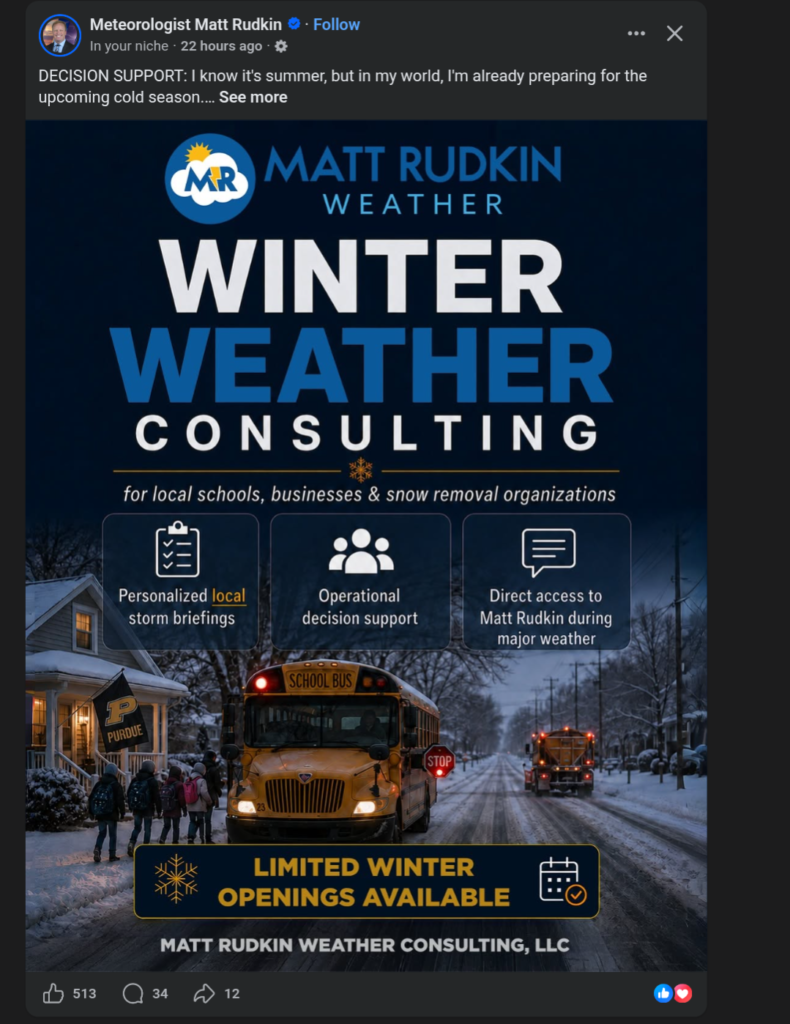
Nationally, there are subscription services for weather-related decision support and data like Perry Weather or Monarch Weather. And, obviously, Accuweather and The Weather Company.
The diversification and specialization of weather forecast information seems to be widening quite quickly.
THIS FEELS LIKE A WIN… BUT FOR WHO?
The expansion of the weather enterprise can be great. We give more options to the “customer” while also expanding the job options for many people in their careers or recent grads entering it.
This expansion allows local TV mets, with all of their local knowledge, to remain local and still provide value to the community as TV jobs are reduced. And with the lower entry point, and lower general cost of data, it means we can see people experiment with new ideas and new ways to reach an audience or a customer-base.
For the audience/customer base this is probably great! Between apps, paid subscriptions, blogs, tiktoks, and facebook pages… it is easier than ever to get a weather forecast. Plus, with so many potential specializations possible, you can get a weather forecast for almost any need: industry, agriculture, energy, wedding planning, a kid’s birthday party, or a golf game.
The lowered “cost of entry” though, can raise a bit of a problem. Think about it. As the number of outlets increases, and the diversification expands, there is a chance that supply outpaces demand. By a lot. And it is for a bit of a unique reason.
Weather is always happening, sure, but five new weather outlets covering the same region in different ways doesn’t create a new customer-base with each next diversification – it just splits the original customer base into smaller chunks. Plus, weather data provided to one customer-base may be applicable to another. An agriculture forecast may need to know temperature, sunlight, dewpoint, wind and rainfall forecasts. But so does an energy trader. And a business owner.
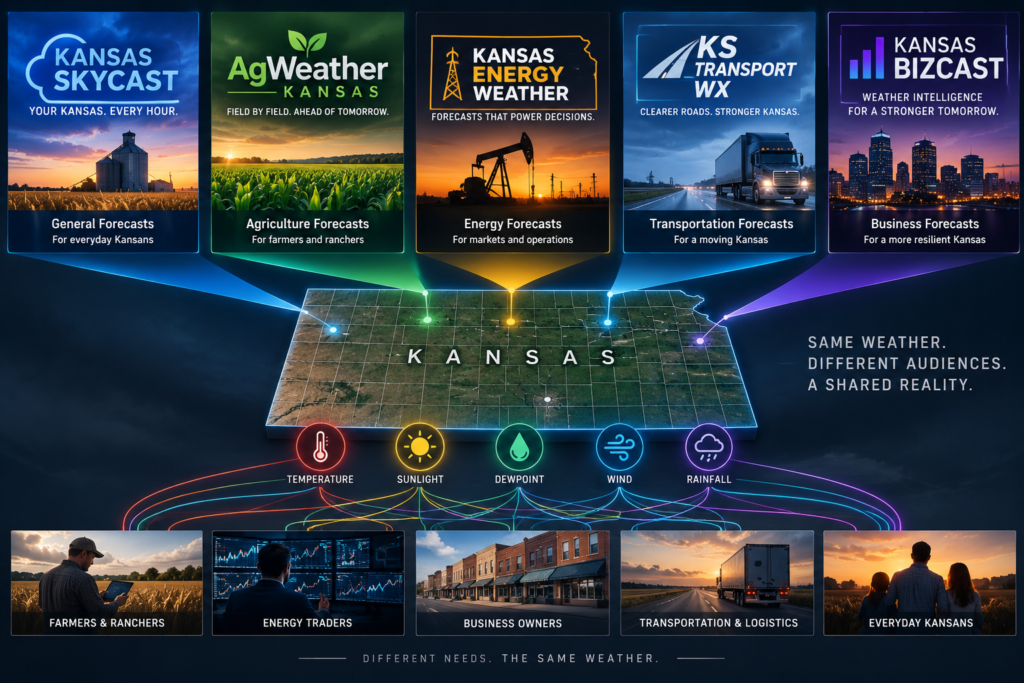
On top of all of that, the profit margin on a weather-related business has never been terribly high. Increased competition and a lower cost of entry could mean that, suddenly, “the next guy” may be able to offer certain services at a much lower cost to the end user (this is why my services are so much cheaper than the competition, fwiw, I employ a LOT of technology).
THE ELEPHANT IN THE ROOM
Holding all of that aside: Basic weather data is essentially free. So what is anyone charging money for?
If people want to know “what’s the weather tomorrow?” they don’t have to look far or hard to find an answer. Between the remaining TV stations producing quality weather forecasts, the infinite number of weather apps, NOAA/NWS, and even smart devices like an Alexa and some expensive refrigerators…. you can easily find out what the weather will do today. Or tomorrow. Or early next week.
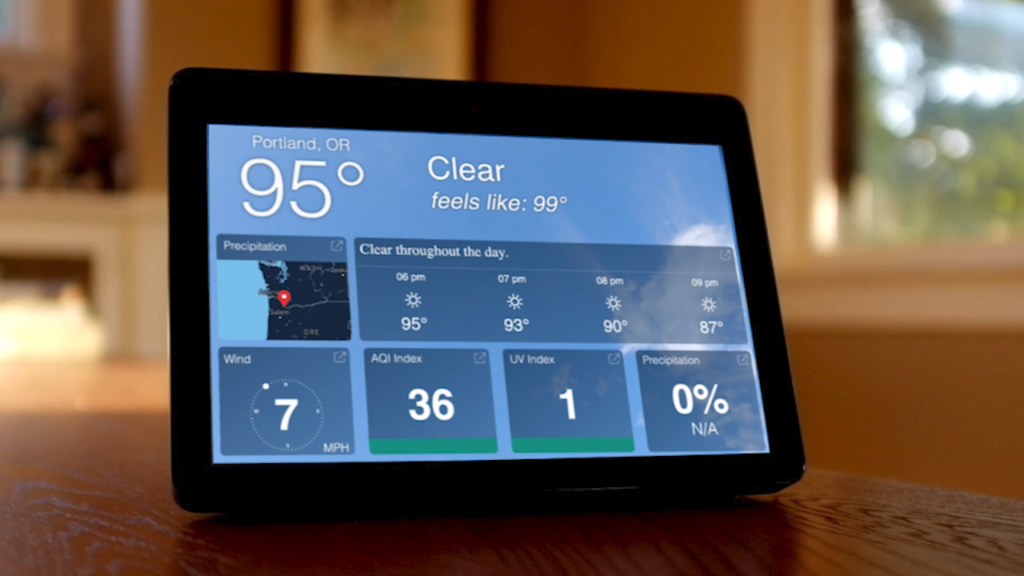
And most people – and businesses – don’t require any added value to “Sunny and 87, with a 40% chance for rain.”
Especially when the modeling – with no human interaction – for today or tomorrow is already incredibly accurate with the general weather. The charts below show the “day of” and “tomorrow” temperature accuracy across the Lower 48. Notice how accurate this data is! An anomaly correlation of greater than 0.95 across most guidance.
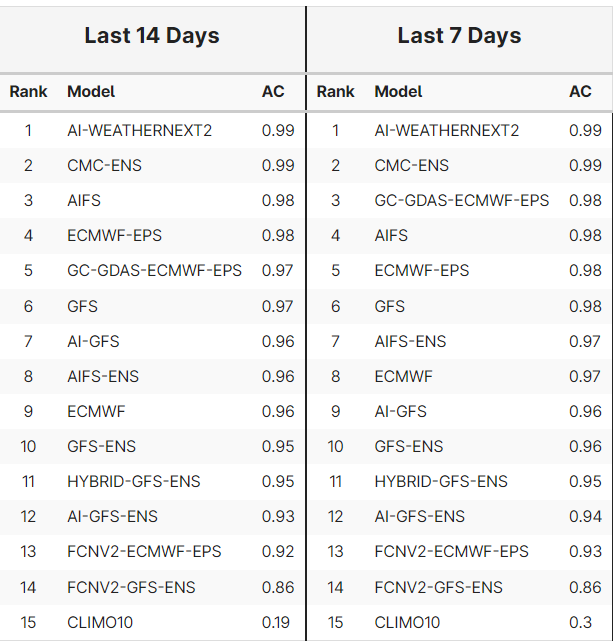
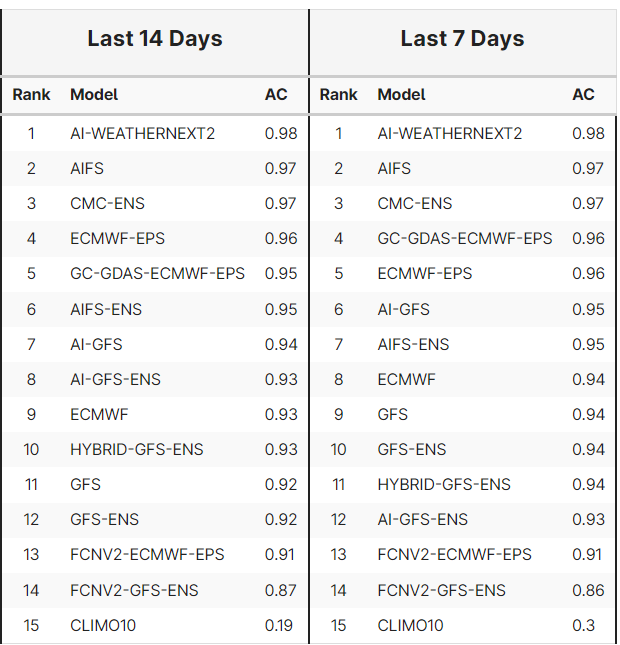
And for the people who just want to know what the weather will do…. this repackaged, generally accurate, and free data is easily available from a potpourri of different sources with varying degrees (no pun intended) of depth.
A great example of this is on social media. In particular, Facebook.
You don’t have to scroll far after searching for “Weather” to find places like, “Super Storm Forecasters 5000” and “First Alert Code Red Weather Authority” pages. But even places like Mike’s Weather Page and Ryan Hall Yall have done just fine at building trust within their communities by providing freely available data – with or without context – without meteorology degrees. And these pages have cultivated a reasonable following with people -very- satisfied with what they are reading.
It means the economic value of “what is the weather going to do tomorrow?” is getting lower by the day. And what meteorologists can charge for is where the economic value still remains: “what does this weather mean for me?”
A METEOROLOGIST AND AN AI BOT WALK INTO A BAR
I know the doom and gloom of “AI is coming for your job” is probably getting very tiresome for a good portion of the population. In this case, though, the AI bot may not be coming for a meteorologists job. The AI bot may help write the code that replaces the job of the meteorologist altogether.
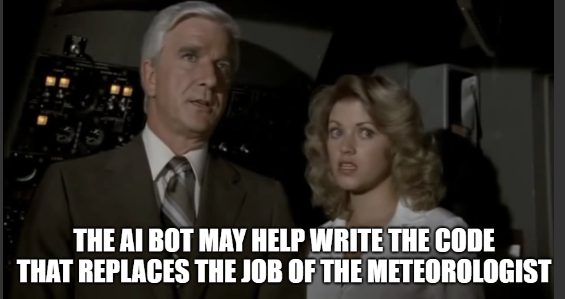
That is for all of you “AIRPLANE!” fans out there….
It turns out that, to change the economy of meteorology, we don’t need an AI bot to replace a human, we just need to write the code that can download, parse, and distribute the data in a meaningful way for an end-user.
Things like….
– Turn raw forecast data into a generic discussion
– Identify changes between model runs
– Flag threshold exceedances
– Generate routine alerts
– Personalize forecast data by location/customer
– Produce graphics
… Can all be done programmatically, without AI. Or we can have AI write the programming to do that.
This is where the Human Meteorologist steps in, though, right?
Historically, meteorologists have been employed for judgement. This is why long-time meteorologists in a given area have a lot of trust. Expansive experience is meaningful because it allows a meteorologist to reflect back on previous situations and make predictions based as much on the math and physics as “what happened last time”
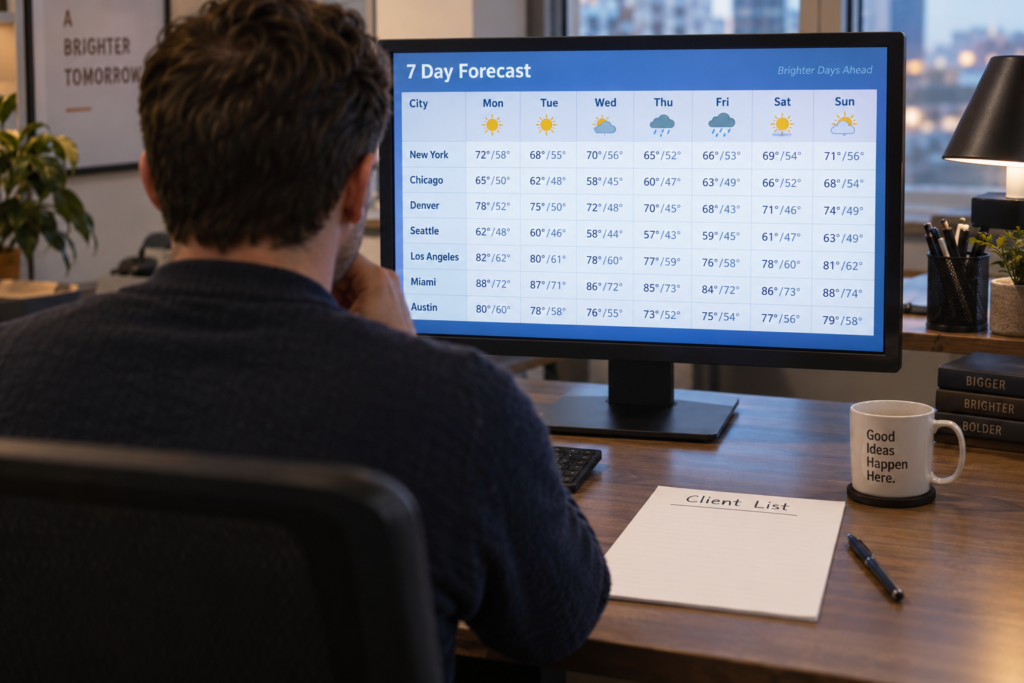
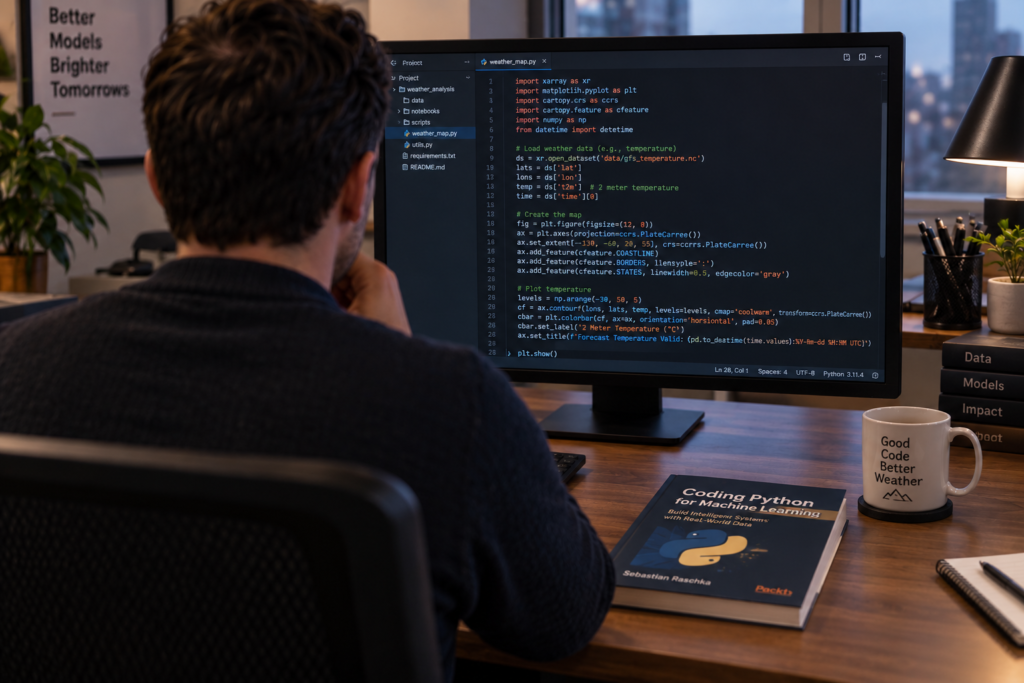
Except, we now have the compute power – and skill – to program the same repeatable judgement. Because repeatable judgement is just what’s known as an “IF/ELSE” statement in programming.
A programming script could be written as….
import pandas as pd
###Load the forecast dataset
data = pd.read_csv(“forecast_data.csv”)
###Calculate how often 500mb heights exceed 5940m
pct_above = (data[“500mb_height”] > 5940).mean()
###Apply meteorologist’s judgment
if pct_above >= 0.60:
mean_height = data[“500mb_height”].mean()
###Increase temperature 1°F per 60m
adjustment = max(0, (mean_height – 5940) / 60)
data[“forecast_temperature”] += adjustment
That is a simple set of code that says, if a 500mb ridge is greater than 5940m then add an additional degree to the forecast high temperature for each 60m of 500mb heights.
That is something a Human Meteorologist would have done in the past in their head. Looked at the 500mb geopotential heights, assessed the pattern, and recognized that in past events, when a ridge was this size, the models under-forecast the highs by a degree or two for a given area and applied the judgement call that the forecast would be warmer than the models suggest.
More complicated decision trees can incorporate probabilities, confidence, lead time, ensemble spread, customer tolerance, operating hours, costs, etc. Repeatable judgment can become automation. Unique situations would still require a human, but for how long?
Taking the programming one step further, we can drill down and bias-correct the modeling for a specific location.
import pandas as pd
###Load the model forecast data
forecast = pd.read_csv(“forecast_data.csv”)
###Load bias corrections based on local forecasting experience
bias = pd.read_csv(“bias_correction.csv”)
###Apply corrections for each city
for _, correction in bias.iterrows():
city = correction[“city”]
forecast.loc[
forecast[“city”] == city,
“day_1”
] += correction[“day_1”]
forecast.loc[
forecast[“city”] == city,
“day_3”
] += correction[“day_3”]
forecast.loc[
forecast[“city”] == city,
“day_7”
] += correction[“day_7”]
This second snippet means that I don’t have to remember that a given model is too cold, too warm, or too humid. I can script my experience into the data to correct the model’s shortcomings. Then, I can let the computer resolve the rest. In real-time.
Big Data with Automation may become the real threat to Meteorologists.
If technology has reduced the cost of entry, the cost of data, and can now turn that data into a forecast, the forecast into a chart, can build a decision tree from the analysis, and turn the decision tree into judgement… then we have effectively taken five of the six steps that a Human Meteorologist once did out of the equation.
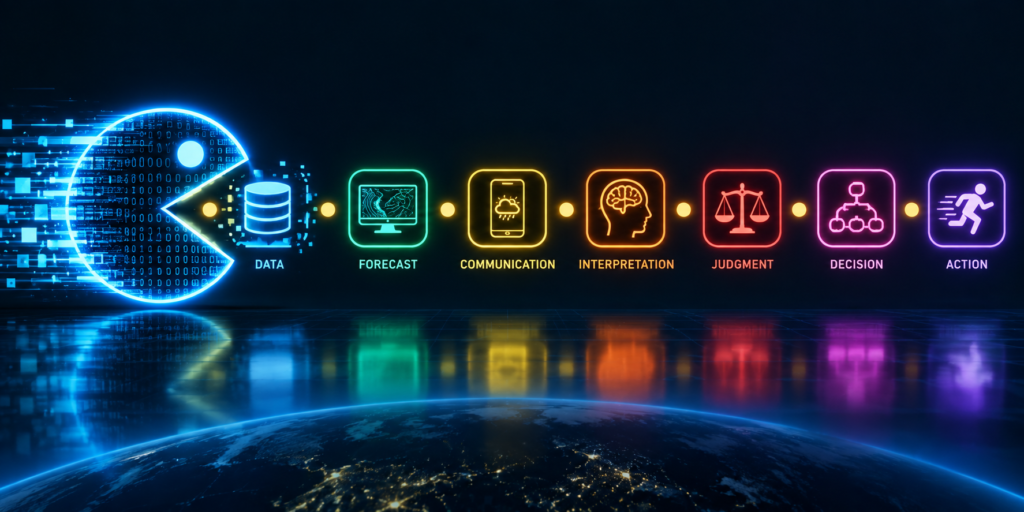
How long until it takes the sixth?
The seventh step on that graphic, “Action”, hasn’t been in the meteorologists wheelhouse, historically. Often, in the past, the meteorologist produced the forecast and allowed the decision-makers to take the action once the forecast was delivered.
Part of that is where weather consulting is stepping in. This is where the economic value, mentioned earlier, still lives.
Offering forecasts specific to a client and being there to help with decision-making. But very few consultants are going to have the capital to protect them from one bad decision without some very, very good (and potentially expensive) liability insurance.
And, we end up back at the same question eventually, anyway. Because we made it this far. So, how soon until the decision is automated, too?
BACK TO SQUARE ONE
And if automation is going to step in and has replace a large chunk of the assembly line of a forecast from Data to Decision, and -perhaps eventually- through Action. Then where are we left as a meteorological field? As people leave television or the NWS looking for weather forecasting roles, there may not be many left.
Honestly: I think we are back at TV’s economic model. Without the TV station.
People will always want to know what the weather will do tomorrow. So they will need to go somewhere to find that information. Meteorologists can’t sell that information for a price. Instead, the audience, itself, becomes the product, and the meteorologist sells the audience to an advertiser.
If weather data itself is free and generally accurate, and contextualizing it can be automated and cheap, but attention produces revenue, the incentive changes. Your business isn’t necessarily rewarded for producing the best forecast, it’s rewarded for producing the largest audience.
The avenues to each of those things looks very different in 2026.
Compare:
Some potential exists for severe weather next Tuesday, although predictability remains low at this range.
versus:
🚨 MAJOR SEVERE WEATHER OUTBREAK POSSIBLE NEXT WEEK! 🚨
Which one gets clicked? Which one gets shared? Which one generates comments? Which one generates ad impressions?
More importantly for people trying to keep a roof over their head, which one produces more revenue?
As Lupe Fiasco once said, “[People] gotta eat, that’s when [it] gets greasy.”
It also helps to explain why the most successful meteorologists people can think of and name are not more accurate by leaps and bounds over the competition. They are the ones with the largest audiences.
NICK, YOU’RE TALKING YOURSELF OUT OF A JOB
In a sense, yes. But in a different sense, not yet.
Sure, eventually automation will take my job as a forecaster and decision supporter. But not yet. In the short term, it is about evolving with the changing landscape.
The days when I sit down, look at a handful of maps from two different models, and produce a high, a low, and a percent-chance-for-rain that is meaningfully better than the forecast that code can generate by analyzing and parsing 15 different models are essentially over.
The code I write can now give me a pretty good “grip-and-rip” forecast before I ever look at a map.
But I still have to understand the atmosphere and how it works. And I still have to write that code.
For everyone else, you have to ask yourself what kind of business do you want to be a part of? The audience for weather forecasts will always be there. The customer-base for a weather forecast may not.
That leaves us with “problems” for every current avenue of meteorology. That doesn’t mean there isn’t money to be made in weather. Clearly, there is. But increasingly, I think it matters where a meteorologist decides to look for it.
Maybe it is specialization. Don’t just know weather, but know weather and energy. Weather and agriculture. Weather and logistics. Weather and emergency management. Understand both what the atmosphere is going to do, and how it interacts with a business’s complicated world.
Maybe it is consulting. Build enough trust with a customer that they aren’t paying you because you’re the only one who gets it right, but because you know their operations, understand their vulnerabilities, can recognize when something unusual may impact their business decisions — and you can tell them when the pre-determined decision-tree stops being useful.
Or maybe it back at TV’s business model: Give away the weather for free, build an audience, sell the audience. Profit.
Or maybe it is a little of all three?
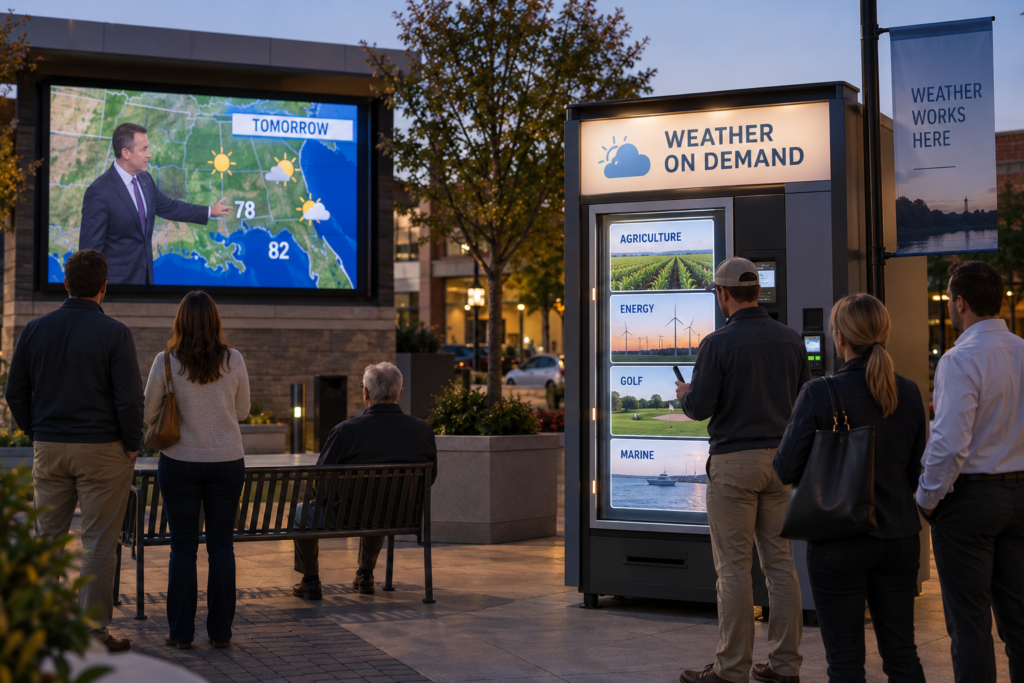
Which leaves us in a strange place.
Because I’m also not convinced there is a giant, untouched customer-base sitting out there waiting for every meteorologist leaving television or the NWS to open a consulting company, launch an app and start charging 10 bucks a month.
Because “What’s the weather going to do tomorrow?” has never been cheaper to answer.
The challenge now is figuring out which question comes next… and whether someone is willing to pay you to answer it.


