A RAP model proximity sounding was pulled from near two areas where tornadoes occurred from the one warm sector supercell. The first was taken at 20 UTC in northwest Texas while the second was from Mangum, Oklahoma, at 22 UTC. At 20z, the profile was extremely favorable for tornadic supercells. Mixed layer CAPE was over 4000 J/KG and there was less than 10 J/KG of CIN. Effective SRH was greater than the typical threshold of 200 for tornadoes and 0-6km shear was at 56 knots.
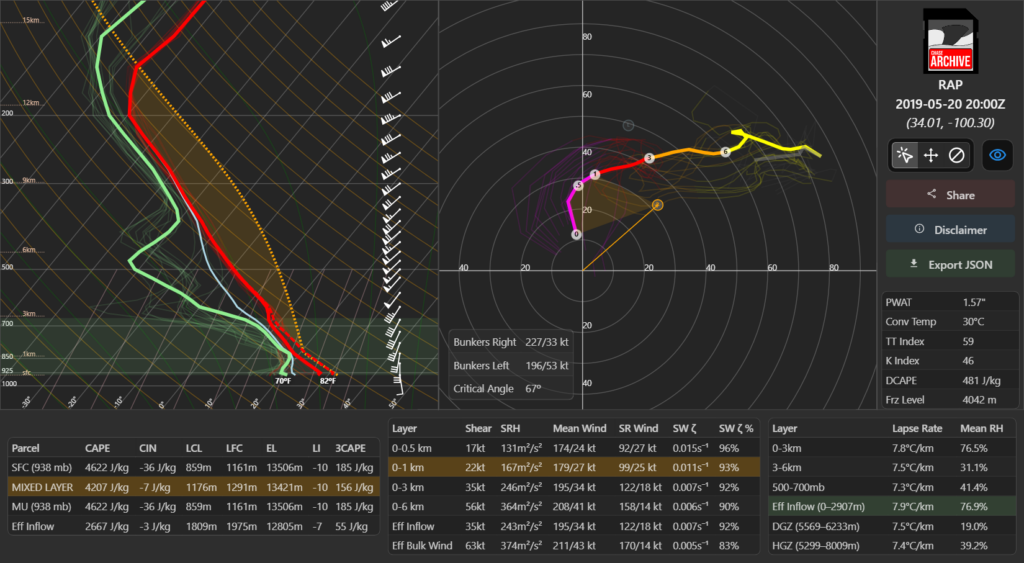
A RAP proximity sounding at 3pm in northwest Texas while the lone warm sector supercell was producing a brief tornado.
In this environment, it was unsurprising that the storm was able to produce tornadoes (Warren at al. 2021). This environment was compared to the 21z Fort Worth sounding (which was the closest in both time and space) . The differences are stark. Although the wind profile is extremely similar (it is actually more favorable at Fort Worth), the thermodynamic profile is significantly different.
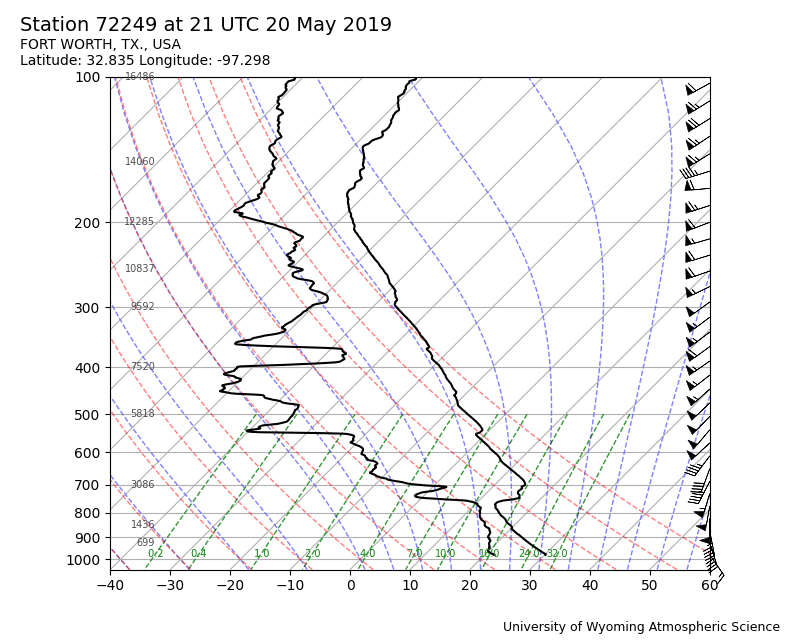
The 4pm NWS Fort Worth sounding. Note the large temperature inversion around 700mb.
On the model sounding, the convective temperature is progged at 30C. On the 21z observed sounding the surface temperature is already 30C yet there is a large temperature inversion above the surface. Even though it is warmer on the observed sounding, the inversion was strong enough to keep the area completely free of any convection. Given the lack of synoptic scale forcing, it is clear that updrafts were not able to reach the LFC and initiate into mature convection.
The next model sounding was taken further to the northeast in southwest Oklahoma. Instability is down to around 2700 J/Kg and CIN has increased.
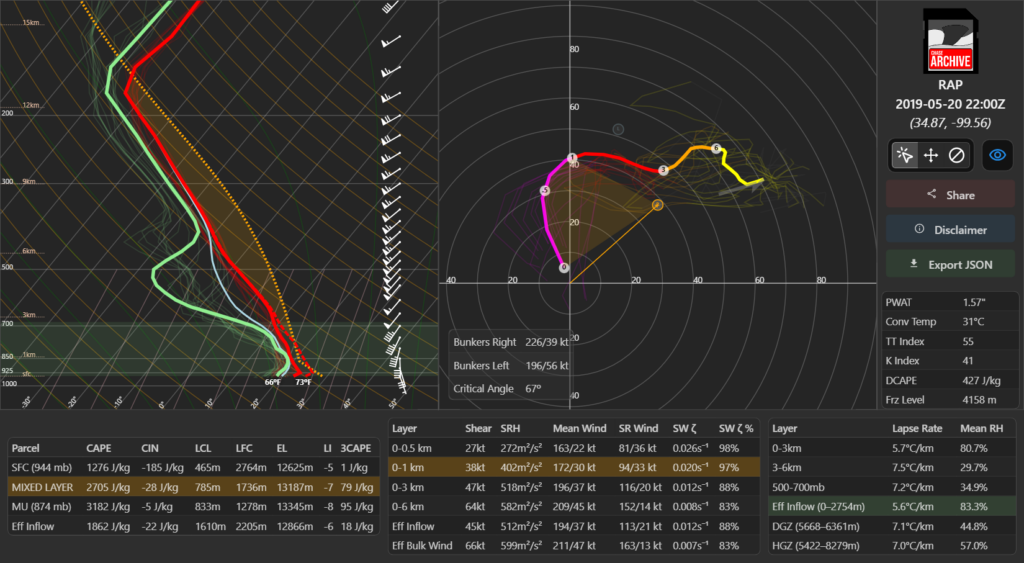
A 5pm RAP proximity sounding for southwest Oklahoma for when the Mangum, Oklahoma, EF2 was ongoing.
Despite this, the supercell produced its strongest tornado at this location. The strength of the low-level shear and the presence of a mature mesocyclone was likely the reason the storm could penetrate the inversion and remain surface-based.
The next sounding compared was the 7pm observed sounding from Norman. Due to the later hour and the further north location, the cap was weaker, as forcing for ascent had lifted and cooled the cap due to the closer proximity to the upper-level trough.
Mixed-layer CAPE was still strong (greater than 3000 J/Kg) and the wind shear was more than sufficient for violent tornadoes, with greater than 500 effective storm relative helicity (Straka at al. 2024). Most strikingly, however, is that there is no CIN with either a surface-based parcel or a mixed-layer parcel. The surface temperature is recorded to be one degree Fahrenheit less than the convective temperature.
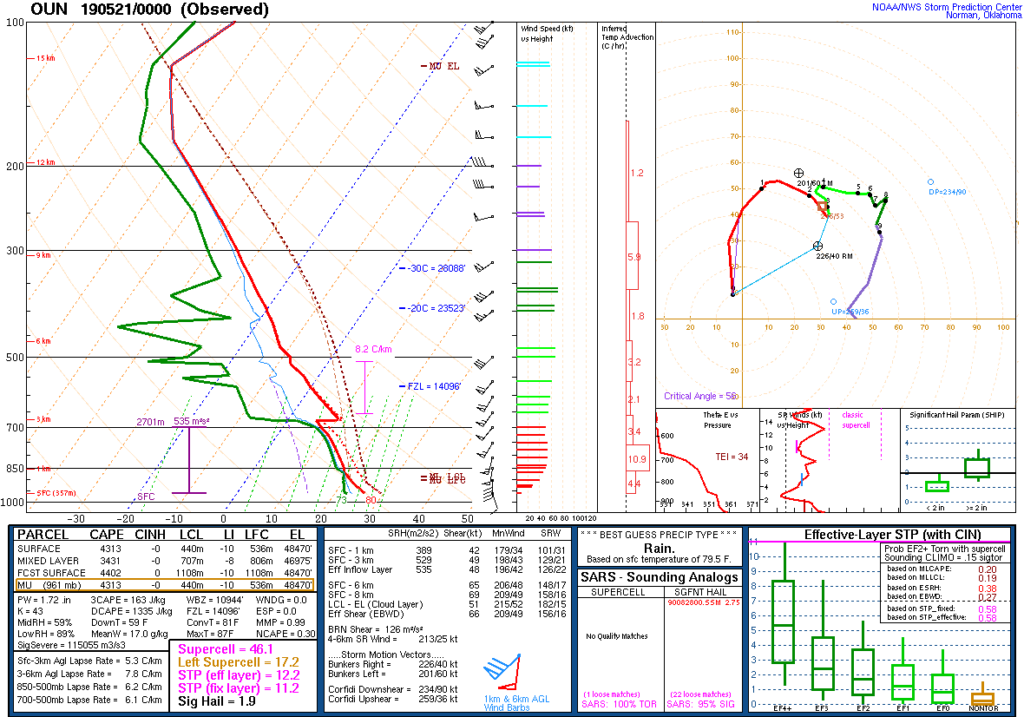
The 7pm Norman, Oklahoma, sounding. Note the temperature inversion just above 700mb.
Despite this, a sharp inversion was situated at 700mb. Surface to three kilometer lapse rates were also measured at 5.3 C per kilometer. This is significantly less than the values that are typically supportive of convective development, especially for significant tornadoes (Davies 2004). As shown with the Mangum tornado, a mature supercell can overcome some low-level stability, but a developing updraft cannot when combined with a lack of large-scale forcing. This low-level stability and weak synoptic lift was just enough to keep updrafts from maturing and allowed the open warm sector to remain free of renegade supercells.
One additional factor worth noting is that most models did not predict the warm front to be pushed south by the elevated convection during the early evening. Once the front surged through, the supercellular tornado threat effectively ended. This may have ended the threat earlier than what was expected, however it is likely not the main reason the event underperformed. No supercells were able to initiate at the peak of daytime heating and the inversion was only likely to strengthen with a loss of daytime heating.
May 20, 2019, will forever be remembered as one of the biggest what-if events. The environment contained a combination of instability and shear that is rarely seen, as evidenced by the 7pm Norman sounding with its STP above 12 (much higher than the usual requirement for violent tornadoes) (Straka at al. 2024). Forecast analogs for the event were similar to those that had brought numerous long-tracked violent tornadoes to the southern Plains.
Although there were dozens of tornadoes (some of which were significant), most of the area was spared from tornadic supercells. This event was a wake-up call to meteorologists and forecasters about the big impacts that a seemingly tiny difference can make in terms of outcomes. Although the surging frontal boundary and destructive storm interactions helped mitigate the threat, the main failure mode was the seemingly small differences in the low-level thermodynamic profile between what the models had forecasted and what actually occurred. Weak low-level lapse rates and a subtle inversion around 700mb combined with weak synoptic scale ascent were just enough to prevent a major tornado outbreak.
Going forward, forecasters and interested parties should closely examine the low-level thermodynamic profile in anticipated tornado outbreaks when open warm-sector convection is expected and synoptic-scale lift is weak.
References
Davies, J. M., 2004: Estimations of CIN and LFC Associated with Tornadic and Nontornadic Supercells. Wea. Forecasting, 19, 714–726, https://doi.org/10.1175/1520-0434(2004)019<0714:EOCALA>2.0.CO;2.
Galarneau, T. J., Jr., and A. J. Clark, 2026: Diagnosing model errors for the 20 May 2019 Oklahoma tornado outbreak. J. Operational Meteor., 14 (6), 72-98, doi: https://doi.org/10.15191/nwajom.2026.1406.
Straka, J. M., V. A. Gensini, K. M. Kanak, and J. M. Garner, 2024: Environmental Conditions Associated with Long-Track Tornadoes. Wea. Forecasting, 40, 3–35, https://doi.org/10.1175/WAF-D-24-0021.1.
Tuckman, P., V. Agard, and K. Emanuel, 2023: Evolution of Convective Energy and Inhibition before Instances of Large CAPE. Mon. Wea. Rev., 151, 321–338, https://doi.org/10.1175/MWR-D-21-0302.1.
Warren, R. A., H. Richter, and R. L. Thompson, 2021: Spectrum of Near-Storm Environments for Significant Severe Right-Moving Supercells in the Contiguous United States. Mon. Wea. Rev., 149, 3299–3323, https://doi.org/10.1175/MWR-D-21-0006.1.


